Supporting Rural Wastewater Across Colorado
Recently, Newterra’s Domain Manager for Decentralized Wastewater, Romina Ferrada, traveled to Colorado for a series of critical site visits to inspect several decentralized wastewater treatment systems currently operating across the state. According to recent Colorado health and demographic data, approximately 82% of Colorado’s landmass is classified as rural or frontier. Despite the state’s predominantly rural geography, only 12–14% of residents live in rural areas.
Since the vast majority of the state’s territory isn’t urbanized or densely settled, more and more small communities are turning to decentralized wastewater treatment as a valuable alternative to traditional “bricks-and-mortar” treatment plants. Water access is especially important in Colorado, where many remote locations lack connections to conventional wastewater infrastructure. In response, remote communities and smaller private developments are finding decentralized systems increasingly practical and affordable. Colorado provides a strong example of this trend, with Newterra expected to be involved in up to 15 projects across the state over the next few years.
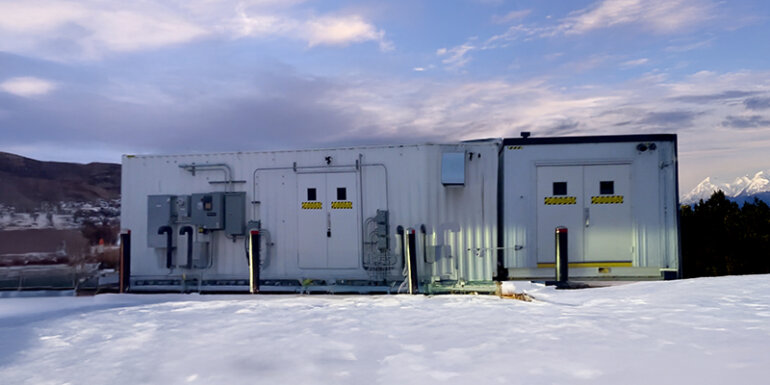
Newterra’s Clear3 MBR wastewater system in the town of Phippsburg, Colorado.
A notable example is the town of Phippsburg, Colorado, where Newterra delivered a 12,363 gpd (46.8 m³/day) Clear3 MBR (membrane bioreactor) wastewater treatment system. Because Newterra’s treatment plants are pre-built and designed to be compact, they can be easily installed on almost any terrain and are engineered to operate reliably in extreme hot and cold temperatures. Newterra’s Romina Ferrada noted, “This remoteness really brings into focus how important a task we have in enabling these communities to have safe, reliable wastewater treatment.”
Another issue facing rural sites is how economically decentralized wastewater treatment can replace aging or failing systems. Septic system failures can range from minor repairs to full drain field collapse or groundwater contamination, often caused by clogging, backups, or design and soil issues.
A great example of this is the Riverdance RV Park, located in Gypsum, Colorado. With approximately 165 full-hookup RV sites, along with additional park-model village lots and amenities, the park faced the challenge of a failing septic system. With so many residents relying on it, management was confronted with a dilemma: would replacing the septic system be viable, or would investing in an all-new MBR wastewater treatment system be the better long-term solution?
Management ultimately chose to replace the outdated system with a more eco-friendly 39,625 gpd (150 m³/day) Clear3 MBR wastewater treatment system. MBR systems require a much smaller footprint compared to most septic systems of this size, which need more space to accommodate large weeping beds. By switching to the smaller footprint of an MBR system, the park was able to regain land that had previously been used for large drain fields. Riverdance owner Chad Cusworth stated, “We’re a full-service RV park, located in the middle of nowhere, so we needed something reliable and long-term. We’re very happy with our new MBR wastewater plant.”
“We’re located in the middle of nowhere, so we needed something reliable and long-term. We’re very happy with our new MBR wastewater plant.” Riverdance Owner, Chad Cusworth
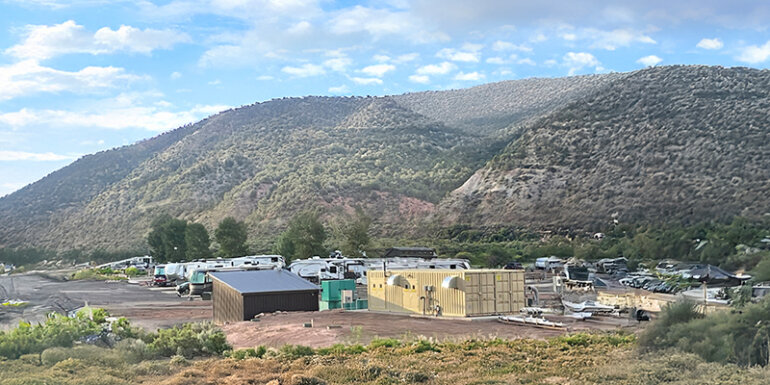
The more eco-friendly Newterra Clear3 MBR system replaced the RV park’s failed septic system.
And finally, Romina and colleagues visited Steamboat Mountain School in Steamboat Springs, Colorado. This small, college-preparatory school focuses on experiential education for students in grades K–12. The school was faced with the challenge of replacing an aging and failing lagoon system and needed a long-term, reliable solution. Newterra was selected based on its ability to be sole-sourced from the beginning. This was made possible through a strong RSM–consultant relationship and by proposing a solution that was well aligned with both the technical demands of the project and its financial constraints. To meet these needs, Newterra supplied a 3,579 gpd (13.55 m³/day) Clear3 MBR wastewater treatment system to replace the school’s aging lagoon system. Through this strong partnership, Romina and her team delivered a cost-effective, high-performance solution that met both the site’s treatment requirements and the project’s tight budget constraints.
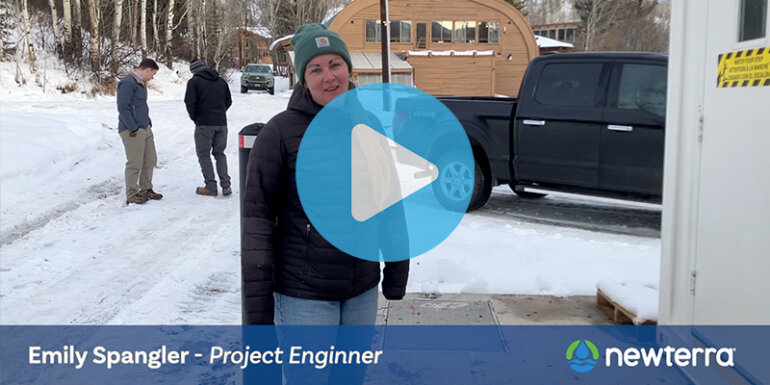
Project Manager Emily Spangler provides an inside look at the Newterra Clear3 MBR wastewater system, serving the Steamboat Mountain School.
Site visits like these are valuable not only for Romina and our colleagues but also for the customer. They provide an opportunity to ensure systems are operating properly and to identify opportunities for further improvements in the design and delivery of our MBR Systems. Input from operators and engineers, shared with site management and owners, helps us better serve our customers and deliver a superior product. This strong relationship extends beyond the initial sale and continues throughout the lifecycle of the system.
Newterra’s decentralized wastewater systems are making a meaningful impact in Colorado by enabling communities to replace aging or failing infrastructure with compact, modular solutions. Projects like the award-winning Telluride, Colorado, project demonstrate how these systems meet strict regulatory requirements, perform reliably in cold and constrained environments, and offer a cost-effective, scalable alternative to traditional centralized treatment.
Want to learn more? If you have questions or would like to explore what Newterra can do for your project, contact us today.