Water Reuse for Safe Food Production
Food and beverage plants rely on massive volumes of high-quality water, yet they face mounting pressure to reduce their freshwater intake and wastewater discharge. Water reuse has emerged as a practical solution, but only when reclaimed water can be trusted as a stable, food-safe utility. Reverse osmosis (RO) is the technology that makes that possible.
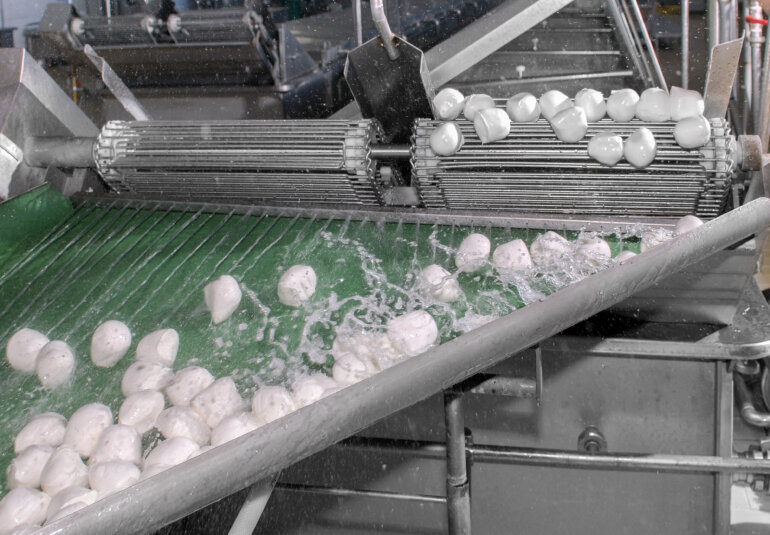
Washing of mozzarella balls on roller conveyor.
Food Plants Need Reliable Water
Food and beverage manufacturing runs on water. It washes raw ingredients, carries heat during blanching and cooling, feeds boilers, and ensures sanitation and Clean-In-Place (CIP) systems are on schedule. The sector must navigate a challenging dual mandate: utilizing massive volumes while meeting some of the industry’s strictest quality standards. When water quality drifts, food safety risk rises, equipment fouls, and production suffers. This reality is pushing more plants toward water reuse—but only if reused water becomes dependable enough to replace traditional fresh supply.
Why Reuse Is Now Essential
Reuse used to be framed mainly as sustainability. Today it is also about operations and growth. Drivers include higher freshwater costs, tighter discharge permits, and real supply uncertainty from drought and allocation limits. At the same time, corporate ESG commitments are moving from soft targets to measurable reductions in intake and discharge. When expansion projects outstrip existing water allocations, reuse becomes a practical tool for keeping lines running and enabling the next phase of capacity.
Reused water must be safe, sanitary, and not introduce allergen cross-contact or increase contamination. Once a reuse system is permitted, implemented and operations are stable, the benefits accumulate quickly. Freshwater needs can drop, and plants become less exposed to drought restrictions or supply interruptions. Reuse water also makes expansion possible without seeking new fresh water allocations—often a time-consuming and expensive process. Finally, reuse provides a clear ESG story grounded in hard numbers. The common thread across all of these outcomes is reliability. The more dependable reuse water becomes, the more it can replace a fresh supply.
RO at the Center of Dependable Reuse
The first step in any reuse program is identifying where reclaimed water can replace a fresh supply without increasing food safety risk. Pre-approval of reuse plans are not always required, but facilities must demonstrate compliance and include reclaimed water systems in their Hazard Analysis and Critical Control Point (HACCP) plans. Facilities also must provide third-party data proving treatment effectiveness. Most facilities start with high-volume, non-product-contact uses such as cooling towers, boiler makeup after polishing, washdown water for floors and equipment exteriors,heaters, chillers, and other utility functions. These applications are cost-effective and deliver substantial water savings quickly. Some plants later validate reuse for product-adjacent functions such as washing or specific ingredient applications, but those uses typically require potable or ingredient-water equivalency, robust disinfection, and a documented risk assessment and validation plan. Across all reuse categories, the governing requirement remains the same: water quality must be consistent enough to protect product, people, and process every day of the year.
Food and beverage plant wastewater is complex. It typically contains high organics, suspended solids, nutrients, and dissolved salts from ingredients, and cleaning chemistry. Biological systems, dissolved air flotation,UV or ozone disinfection, activated carbon filtration and multi media filtration (MMF) can remove much of the organics and solids, but they often cannot consistently control dissolved salts and many dissolved or trace constituents that drive conductivity, scaling, taste and odor, or long-term equipment stress. Reverse osmosis addresses that dissolved fraction by rejecting most dissolved salts and many smaller dissolved contaminants, creating permeate that can remain within specification even as upstream wastewater quality varies, provided the membranes are protected and performance is monitored.
RO matters in reuse systems because it captures what earlier stages leave behind. It is especially effective at removing dissolved salts and many trace constituents. For food and beverage plants, that translates into two major advantages:
- A clear barrier in water safety plans. RO performance is typically verified through permeate conductivity trending for salt rejection, and flow performance, and alarm logic. Combined with disinfection and routine verification sampling, this monitoring can support HACCP-aligned documentation.
- Better equipment protection. With conductivity drivers and scaling precursors removed, boilers, cooling systems, and reuse applications operate longer with fewer surprises.
Designing The Treatment System
RO works best as the final polishing step in a multi-barrier system. A typical food or beverage plant reuse train includes:
- Equalization and pretreatment to buffer load swings and remove gross solids and fats, oils, and grease.
- Biological and/or chemical treatment to reduce BOD/COD and stabilize membrane fouling potential.
- Clarification and filtration, often via DAF, multi media filtration (MMF), clarifier, or ultrafiltration, to protect RO from fine solids.
- Reverse Osmosis treatment to deliver stable, high-quality reuse water.
- Post-treatment and distribution with disinfection, storage, and dedicated reuse piping.
The most successful programs design backward from RO needs and invest heavily in protecting the membranes upstream.
RO is powerful, but it is not a standalone solution. Food wastewater can swing sharply between production hours and cleaning cycles, and those swings can spike salinity, solids, or organics that accelerate fouling. Strong pretreatment is what keeps RO stable. Equalization volume, if it is included,must be sized for worst-case variability, not average days. Pretreatment should address scaling indices, oils and grease, and remaining organics. Antiscalant dosing and a clearly defined CIP strategy round out the protection plan. When those elements are in place, RO can run at high recovery with predictable maintenance.
Two design priorities emerge in nearly every reuse project. First is variability management: seasonal product shifts, different product lines, and cleaning surges all change water quality, requiring and real-time monitoring to keep RO feed steady. Second is fouling control: scaling, corrosion, and biofouling are the main threats to RO uptime, and addressing them requires upstream stability, and periodic CIP based on data rather than guesswork. Plants that treat these as core design problems typically achieve the best reliability and life-cycle cost.
Getting Started With Water Reuse
If you are considering reuse in a food or beverage facility, a straightforward path usually works best. Start with a reuse map that identifies where reclaimed water can safely replace fresh supply, and rank those uses by risk and volume. Typically, the higher volume of water and more the more pure the water, the easier the treatment process is and the faster the payback. Define internal specifications by reuse category. Audit wastewater quality through its worst week, not just average conditions. Design the treatment train backward from RO feed requirements, ensuring equalization and pretreatment can protect membranes. Then build validation and monitoring into the project early, including sampling plans, HACCP (Hazard Analysis and Critical Control Points), permitting, and operator training.Water reuse is becoming a core strategy for safe, resilient food or beverage production. But reuse only works when water quality is consistent enough to protect product, equipment, and compliance. Reverse osmosis delivers that consistency. With the right State and Federal approvals, third-party validations, pretreatment, monitoring, and validation, RO-powered reuse lets food or beverage plants cut intake, reduce discharge, and expand capacity without compromising the standards that keep food safe.