Decades of Proven Aquaculture Aeration
Aquaculture has become one of the most important food-production industries in the world.
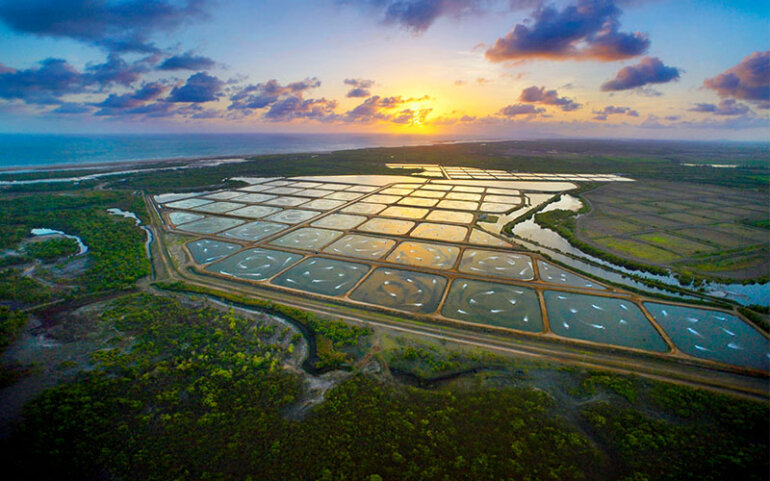
Over the past five decades, global aquaculture has grown from a niche practice into the fastest-growing sector in animal protein production. Today, more than half of the seafood consumed globally comes from farmed systems, and demand continues to rise as coastal fish stocks face pressure from overfishing, climate change, and habitat decline.
What began as pond-based farming in the 1970s has evolved into highly engineered production systems that rely on consistent water quality, oxygenation, and environmental control. As the industry matured, operators increasingly turned toward technologies that keep fish and shrimp healthy, protect water resources, and improve feed conversion and yield. This progression from low-tech ponds to sophisticated recirculating and intensive systems parallels the same decades during which Newterra developed and refined its own aeration and mixing technologies.
Founded in Chaska, Minnesota in 1974, Aeration Industries International (now Newterra) began designing and manufacturing aeration and mixing units with a simple vision: to improve the health of Minnesota’s fresh waters and their ecosystems. Today, the company provides process aerators, mixing equipment, and advanced wastewater treatment systems to industrial and municipal wastewater treatment facilities.
Newterra Launches Solutions for a Thriving Aquaculture Industry
By the 1970s–1980s, as intensive aquaculture systems for tilapia, shrimp, and salmon became widespread, these farms began employing emerging technologies like aeration to improve their water resource management. In 1989, in response to demand for their technologies, Aeration Industries International introduced the Aquaculture Aspirator to serve this rapidly growing global industry.
At the core of aquaculture success is a simple truth: consistent oxygen and circulation produce healthier stock and higher yields. Newterra surface aerators and aspirators deliver efficient oxygen transfer and robust mixing, preventing stratification, minimizing ammonia buildup, and maintaining stable dissolved oxygen (DO) levels across ponds and tanks.
The technology was well received and quickly adopted throughout the aquaculture sector.
In the decades since, operators from shrimp farms to tilapia ponds worldwide have relied on Newterra’s Aquaculture Aspirator for stable, efficient, and high-performance aeration. Aquaculture operators around the globe trust Newterra to maintain healthy, productive water systems. From shrimp farms in South America and Southeast Asia to fish hatcheries in North America, floating aerators and mixers have earned a reputation for reliability, efficiency, and proven performance in the world’s most challenging environments.
Dependable Performance for Sustainable Aquaculture
Built for rugged, year-round operation, Newterra units feature corrosion-resistant construction and minimal maintenance requirements which is ideal for operators who need dependable performance in constantly changing water conditions. Their floating, self-adjusting design ensures optimal oxygen delivery even as water levels fluctuate, while energy-efficient motors help reduce long-term operating costs.
When one of our long-term clients, a tilapia farm in Central America, faced sudden cold weather that caused dissolved oxygen levels to drop dangerously low, Newterra was able to support by quickly deploying its energy-efficient surface-mounted aspirators, delivering emergency aeration and mixing to restore stable water conditions. By improving oxygen transfer with minimal power demand, the system not only protected the fish stock but also supported a more sustainable, resilient aquaculture operation which helped the farm maintain production while reducing environmental impact.
Balancing Efficiency, Yield, and Environmental Stewardship
Healthy aquaculture has always depended on clean, oxygen-rich water, but as stocking densities have increased and temperature fluctuations due to global climate change have became more common, reliable aeration has evolved from a best practice into a non-negotiable requirement. Water quality is easily recognized as the single most important factor influencing fish survival, growth rates, feed efficiency, and disease resistance. Effective aeration systems help farmers maintain stable dissolved oxygen levels, avoid harmful algal dynamics, and keep metabolic byproducts within safe ranges—all essential components of profitable, responsible aquaculture.
Newterra aeration and mixing systems remain a cornerstone technology in sustainable aquaculture. Combining decades of field experience with Newterra’s commitment to innovation, these systems help farmers worldwide optimize production, protect aquatic health, and operate more efficiently.
Newterra supported Pacific Reef Fisheries’ Black Tiger Prawn farm in North Queensland, Australia, by enhancing aeration processes to meet strict wastewater effluent limits. Located near the pristine Great Barrier Reef, the farm must comply with rigorous environmental standards. Our solutions improved aeration efficiency, reduced energy use, boosted yields, and helped the facility maintain its ASC certification for sustainable, responsible aquaculture.
“Beyond the minimal maintenance benefits, emphasized that reliability is the primary reason PRF uses Newterra aerators”
– General Manager and Vice President of the Australian Prawn Farmers Association, John Moloney
Read more here: Pacific Reef Fisheries | Newterra
“As someone who’s worked in this industry for years, I’m proud to recommend Newterra’s Aquaculture Aspirator The way it improves mixing, creates fine microbubbles for higher oxygen transfer, and still allows sunlight to fuel natural photosynthesis speaks to the thoughtful engineering behind it. It’s technology I trust, and I’m proud to bring it to our clients.”
– Jorge Walkup, Regional Sales Manager
Aquaculture’s Role in Sustainability and Food Security
Aquaculture today sits at the intersection of food security, environmental stewardship, and technological innovation. As the global population grows, aquaculture provides an efficient source of protein that requires less land, less freshwater, and produces lower greenhouse-gas emissions than many terrestrial farming systems. But modern operators are under increasing pressure to deliver this protein sustainably by minimizing water impacts, reducing energy consumption, and preserving local ecosystems.
Reliable aeration and mixing systems can support these goals by helping farms maintain stable growing conditions while using water and energy efficiently. Whether in warm-water shrimp ponds, cool-water tilapia operations, or temperate salmonid hatcheries, technologies that promote oxygenation and circulation will remain central to raising healthy stock in an environmentally conscious way.
Conclusion
Technologies that provide consistent, dependable aeration regardless of weather, water depth, or stocking density will continue to play a defining role in the industry’s ability to grow sustainably. The long-term industry trajectory underscores why decades of proven aeration engineering matter. As aquaculture evolves, the need for rugged, efficient, field-tested water technologies grows right alongside it. Honoring the last 40 years of its legacy, Newterra will continue to support this industry long into the future.
Learn more about Aquaculture: Aquaculture Water Treatment and Aeration Systems | Newterra