Granular Activated Carbon for Trace Contaminant Removal in Water Reuse
Water reuse is becoming a practical necessity across food and beverage, industrial manufacturing, and remediation projects. Facilities are under pressure to reduce freshwater intake, lower discharge volumes, and maximize the value of water already moving through their processes. In many cases, conventional treatment removes the bulk of solids and organic load. The challenge isn’t just removing bulk contaminants. It’s what remains at low concentrations after conventional treatment, particularly when reuse water needs to meet a defined quality standard.
Trace contaminants are often the hidden barrier to successful reuse and granular activated carbon (GAC) is one of the most effective tools for reducing many dissolved organic contaminants and emerging contaminants in water treatment systems.
Why Trace Contaminants Can Limit Reuse
After biological treatment and filtration, reuse water can still contain dissolved organic compounds, residual surfactants from cleaning processes, selected hydrocarbons, certain volatile organic compounds (VOCs), or emerging contaminants such as PFAS. Depending on the application, these trace contaminants can affect water quality objectives, create operational challenges, or impact downstream treatment processes.
Trace contaminants may contribute to odor, color, or taste issues in treated water. They can also interfere with sensitive downstream equipment or treatment technologies. In regulated environments, fluctuations in certain compounds may trigger additional monitoring requirements or operational concerns. Most importantly, variability can reduce confidence in reuse performance.
For water reuse to function like a reliable utility, water quality must be stable and consistent. That is where granular activated carbon often plays a critical role.
How Granular Activated Carbon (GAC) Works in Water Treatment Systems
Granular activated carbon, or GAC, removes contaminants through adsorption. Unlike filtration, which physically strains particles, adsorption captures dissolved molecules onto the surface of the carbon media. Because activated carbon has an extremely large internal surface area created by its pore structure, it is particularly effective at reducing many dissolved organic compounds.
GAC performs well for:
- Many dissolved organic compounds
- Taste and odor-causing compounds
- Many PFAS compounds, depending on water chemistry, carbon selection, and system design
- Selected hydrocarbons, solvents, and cleaning-related compounds with favorable adsorption characteristics
- Residual surfactants and other trace organics in certain applications
Performance depends on the specific compound being treated, water chemistry, and system design. Not all organic contaminants adsorb equally, which is why pilot testing, treatability evaluations, and proper system design are important components of successful GAC implementation.
It is also important to understand what GAC does not target effectively. It is not designed to remove dissolved salts, ammonia, nitrate, or most inorganic contaminants. Those typically require technologies such as reverse osmosis, ion exchange, or other specialized treatment processes. As a result, GAC is often integrated into a broader treatment strategy rather than used as a standalone solution.
Where GAC Fits in a Reuse Treatment Train
In engineered reuse systems, GAC is commonly positioned as a polishing step after primary and secondary treatment. A typical sequence may include:
[IMAGE: Equalization → Biological Treatment → Filtration → GAC → Reverse Osmosis or Disinfection]
Upstream biological processes remove bulk organics and reduce biochemical oxygen demand. Filtration captures suspended solids. GAC then adsorbs many remaining dissolved organic compounds that could otherwise create downstream operational challenges.
Depending on the reuse objective, additional polishing technologies such as reverse osmosis, ion exchange, advanced oxidation, or disinfection may follow GAC. When reverse osmosis is included, placing GAC upstream can help reduce organic loading, decrease membrane fouling potential, and support more consistent system performance.
In applications that do not require advanced polishing technologies, GAC may serve as a final polishing barrier before disinfection and reuse distribution, or before discharge when appropriate.
GAC for PFAS and Compliance Control
Granular activated carbon is widely used for PFAS treatment. PFAS has become a priority as regulatory scrutiny grows across industrial and municipal programs. Even when site-specific limits vary, many facilities need tighter control of emerging contaminants and a more rigorous monitoring approach.
In reuse applications, expectations can be higher because treated water supports ongoing operations. That’s why PFAS treatment strategies often emphasize proven adsorption performance, routine sampling, and planned carbon changeout to manage breakthrough risk.
In many systems, GAC vessels are arranged in a lead-lag configuration. The first vessel captures the majority of the contaminants, while the second acts as a safety barrier to reduce the risk of breakthrough.
Performance depends on the PFAS compounds present, carbon selection, water chemistry, and empty bed contact time—the duration water spends in contact with the carbon media. Monitoring and scheduled carbon changeout remain essential for maintaining performance. When properly engineered, GAC provides a proven and well-understood option for reducing many PFAS compounds and other organic contaminants in reuse applications.
Design and Operating Considerations
Successful GAC deployment depends on thoughtful design and ongoing monitoring. Key factors include:
- Empty bed contact time appropriate for the contaminant profile
- Proper carbon selection based on adsorption characteristics
- Vessel sizing to match flow rates and target removal goals
- Pressure drop monitoring to identify fouling or channeling
- Scheduled carbon replacement before breakthrough occurs
- Routine verification sampling and trend tracking using indicators such as TOC or UV254, where applicable
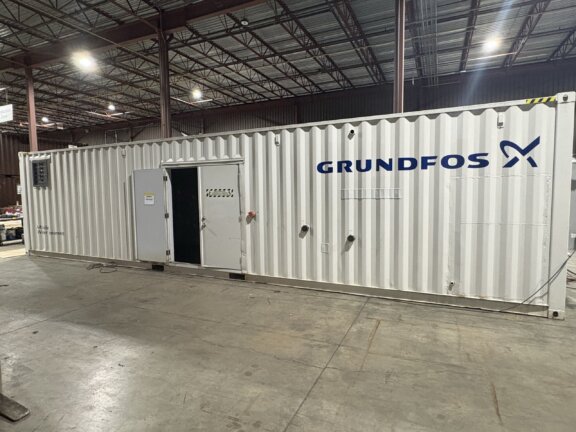
In modular and containerized systems, GAC vessels can be installed in parallel or series to accommodate higher flows or phased expansion. Because GAC systems are passive and mechanically simple, they adapt well to mobile treatment systems and temporary treatment deployments.
Turning Treated Water into Reusable Water
Water reuse succeeds when treated effluent becomes reliable enough to function as a consistent process supply, and that requires more than meeting minimum discharge limits. Granular activated carbon helps bridge the gap by reducing many trace organic contaminants, protecting downstream equipment, and supporting water quality objectives.
While it is not a universal solution for every contaminant, GAC remains one of the most widely applied and proven technologies for managing dissolved organics and many emerging contaminants, including PFAS, within water reuse systems. When integrated into a well-designed treatment train, GAC can play a critical role in turning treated water into a dependable reuse resource.